If you are learning basic math, solving word problems, or helping children with homework, you have probably seen the phrase “how many” used in questions. Although it sounds simple, many students struggle to understand what “how many” actually means in math and what kind of answer the question expects.
In math, “how many” usually asks for the number or quantity of something. It helps people count objects, compare amounts, solve equations, and answer word problems. Teachers commonly use this phrase in elementary math because it encourages students to think about totals, groups, addition, subtraction, multiplication, or division.
For example:
- “How many apples are in the basket?”
- “How many students are in the classroom?”
- “If you have 5 candies and get 3 more, how many candies do you have now?”
In each example, the question asks for a numerical answer.
Understanding “how many” is important because it appears in almost every level of math, from simple counting exercises to advanced problem-solving. In this guide, you’ll learn what “how many” means in math, how to solve these questions, examples, common operations used, and tips for answering math word problems correctly.
What Does “How Many” Meaning in Math?
In math, “how many” asks for the quantity, amount, or total number of something.
The phrase usually requires a numerical answer instead of a yes-or-no response. Students often see “how many” in word problems, counting exercises, and real-life math situations.
For example:
- “How many pencils are on the table?”
- “How many cookies are left?”
- “How many books did she buy?”
In each case, the goal is to find the total number.
“How many” questions often involve:
- Counting
- Addition
- Subtraction
- Multiplication
- Division
The math operation depends on the information given in the problem.
How “How Many” Works in Math Problems
Math word problems often use “how many” to ask students to calculate an answer using numbers provided in the question.
For example:
- “Sarah has 4 apples. She buys 3 more apples. How many apples does she have now?”
To solve:
4 + 3 = 7
Answer:
Sarah has 7 apples.
In this example, “how many” signals that you must find the total quantity.
Sometimes, the phrase may require subtraction instead.
Example:
- “There were 10 birds in a tree. 4 birds flew away. How many birds are left?”
To solve:
10 − 4 = 6
Answer:
6 birds remain.
Therefore, understanding the context helps determine which math operation to use.
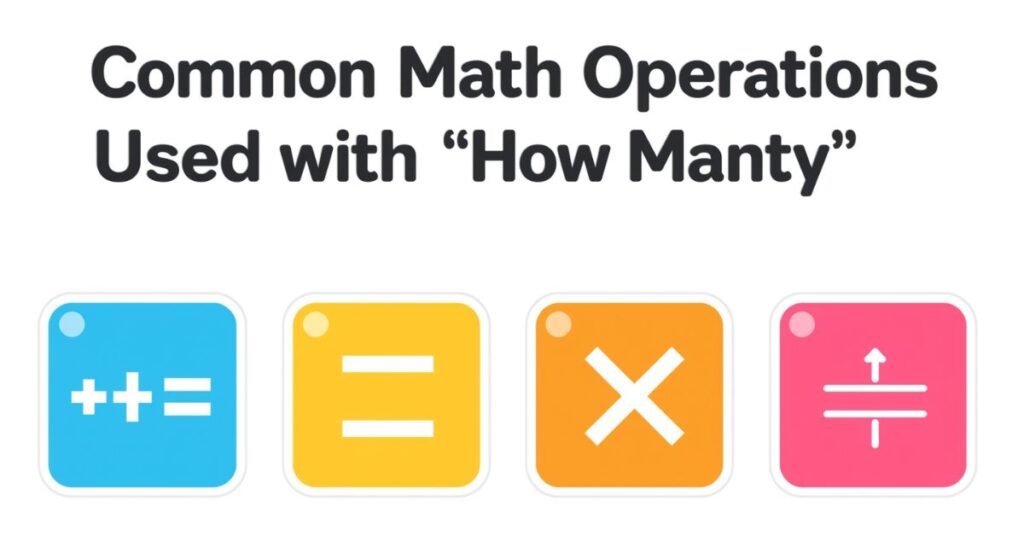
Common Math Operations Used with “How Many”
Addition
People use addition when combining groups or finding totals.
Example:
- “Tom has 2 toy cars and gets 5 more. How many toy cars does he have?”
2+5=72+5=72+5=7
Answer:
7 toy cars
Subtraction
Subtraction helps find how many remain after removing items.
Example:
- “There were 12 cookies. 5 were eaten. How many are left?”
12−5=712-5=712−5=7
Answer:
7 cookies remain
Multiplication
Multiplication works when equal groups appear in the problem.
Example:
- “There are 4 bags with 3 apples each. How many apples are there altogether?”
4×3=124\times3=124×3=12
Answer:
12 apples
Division
Division helps split quantities into equal groups.
Example:
- “12 candies are shared among 3 children. How many candies does each child get?”
12÷3=412\div3=412÷3=4
Answer:
4 candies each
Why “How Many” Is Important in Math
“How many” questions help students:
- Develop counting skills
- Understand quantities
- Practice problem-solving
- Learn basic operations
- Apply math in daily life
Teachers use these questions because they connect math concepts to real-world situations.
Tips for Solving “How Many” Questions
Read Carefully
Understand exactly what the question asks.
Identify Keywords
Look for clues like:
- Total
- Left
- Altogether
- Each
- Shared equally
Choose the Correct Operation
Decide whether to use addition, subtraction, multiplication, or division.
Double-Check Your Answer
Make sure the final number makes sense in the context of the problem.
Examples of “How Many” in Everyday Life
People use “how many” outside school all the time.
Examples include:
- “How many people are coming to dinner?”
- “How many minutes are left?”
- “How many dollars does this cost?”
- “How many goals did the team score?”
These questions all ask for quantity or amount.
Frequently Asked Questions About “How Many” in Math
What does “how many” mean in math?
It asks for the quantity, amount, or total number of something.
Is “how many” always addition?
No. “How many” may involve addition, subtraction, multiplication, or division depending on the problem.
Why do teachers use “how many” questions?
Teachers use them to help students practice counting, problem-solving, and math operations.
What kind of answer does “how many” need?
It requires a numerical answer showing quantity or amount.
Can “how many” appear in advanced math?
Yes. Although common in elementary math, the phrase also appears in algebra, statistics, and higher-level problem-solving.
How do you know which operation to use?
You determine the operation by reading the context and identifying keywords in the problem.
What is the difference between “how many” and “how much”?
“How many” refers to countable items, while “how much” usually refers to uncountable amounts like money, water, or time.
Conclusion
In math, “how many” asks for the number, quantity, or total amount of something. These questions help students practice counting and solve problems using addition, subtraction, multiplication, or division.
Because “how many” appears in everyday life and nearly every level of mathematics, understanding its meaning is an important skill for learners of all ages. By reading carefully, identifying clues, and choosing the correct operation, students can solve “how many” problems more confidently and accurately.

I am William Turner, a lover of clever words and playful ideas. I turn everyday moments into laughs and smiles. On punsprout.com, I share fresh puns and witty content to keep creativity growing.